Layer 01Ecommerce Fulfilment
The EU's new 3 euro low-value duty is a SKU-data problem for 3D print sellers
From 1 July 2026, low-value ecommerce imports into the EU face a temporary 3 euro customs duty per tariff classification. Here is what 3D print sellers should change in pricing, HS codes, bundles and fulfilment before it hits margins and buyer trust.
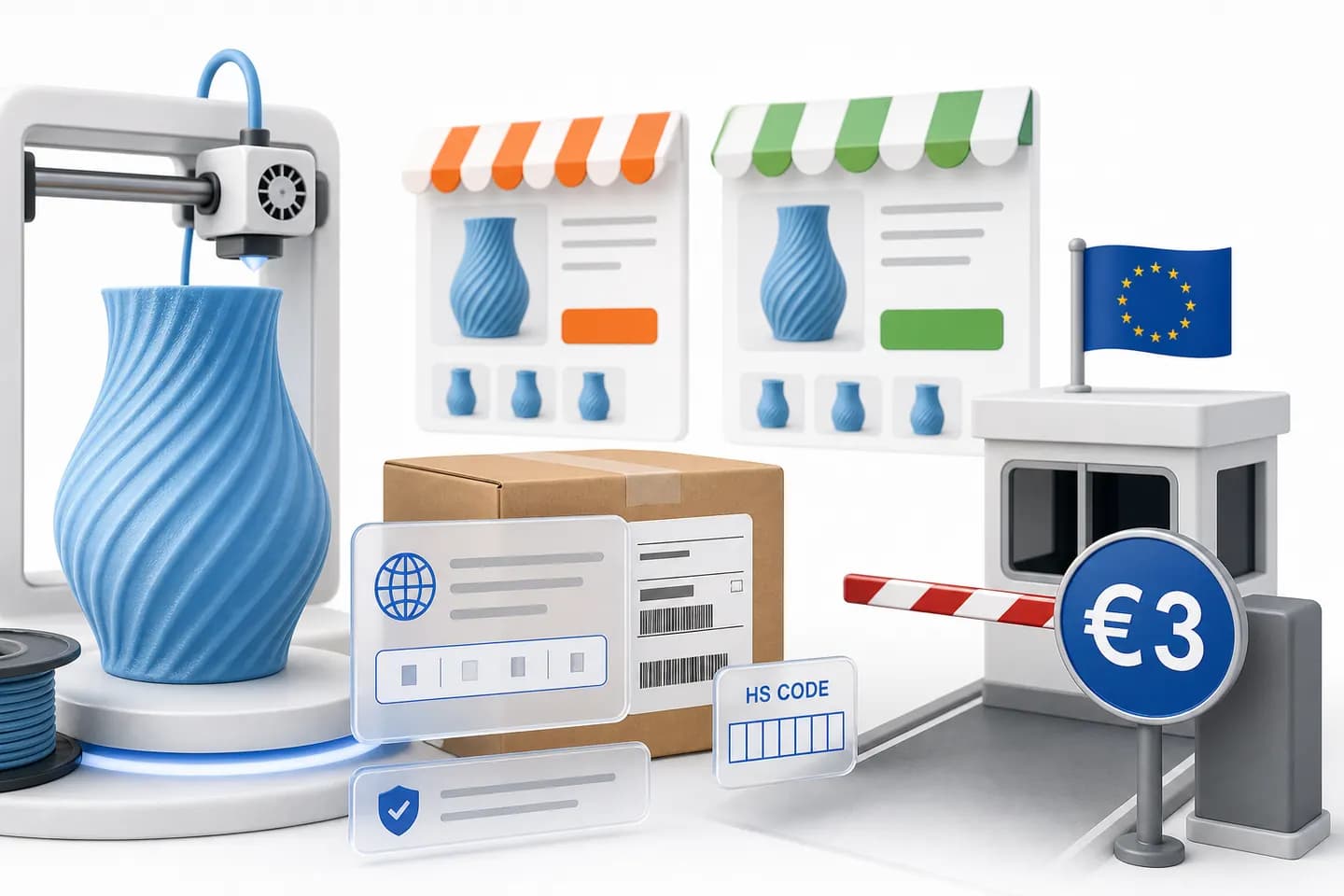
A genuinely current change is about to hit small cross-border ecommerce parcels into the EU. From 1 July 2026, the EU removes the customs duty exemption for ecommerce consignments valued at 150 euro or less and replaces it, until 1 July 2028, with a temporary 3 euro customs duty. The important detail for 3D print sellers is that the charge is not simply "3 euro per order". The European Commission describes it as applying per item in a consignment, based on tariff classification; Shopify's current EU tax guidance summarises this as 3 euro per tariff classification, not per parcel.
That sounds like a tax story, but for creators it is really a product-data and fulfilment story. Low-ticket 3D printed goods often sit exactly in the range where a few euros can decide whether a buyer completes checkout: keyrings, cosplay clips, cable organisers, desk accessories, tabletop terrain, replacement knobs, tool holders and small PETG utility parts. If a basket contains several product types with different classifications, the customs charge can stack. If HS codes, country of origin, IOSS/DDP setup or checkout wording are wrong, the buyer may see a surprise charge at delivery, a delay, or a support thread that wipes out the margin on the order.
What changed
- The old low-value customs duty relief for EU ecommerce imports under 150 euro ends on 30 June 2026.
- From 1 July 2026, a temporary 3 euro customs duty applies to qualifying low-value distance-sale imports into the EU.
- The duty is linked to tariff classification lines rather than being a simple per-parcel fee. Multiple distinct product categories in one parcel can mean multiple 3 euro charges.
- The EU also introduces a product-identifier direction of travel: product identifiers can be supplied voluntarily from 1 July 2026 and become mandatory from 1 November 2026 for relevant low-value ecommerce imports.
- VAT rules are separate. IOSS can still matter for VAT on eligible low-value orders, but sellers should not assume IOSS alone solves the customs duty problem.
- Shopify has already updated its EU tax guidance to tell merchants to confirm duties settings before 1 July 2026 and to ensure accurate HS codes. Etsy's buyer help now also explains that for EU imports from outside the EU, VAT and customs duties apply from 1 July 2026, with the treatment depending on how the seller ships the item.
Why 3D print sellers should care
First, many 3D printed products are low-value but fulfilment-heavy. A 3 euro duty on a 12 euro accessory is a very different commercial event from a 3 euro duty on a 95 euro custom part. Sellers who price mostly from filament grams plus print time will under-model the new landed cost if they do not add customs duty, marketplace fees, payment fees, packing labour, returns and support time.
Second, 3D print catalogues are usually variant-rich. The same design might be sold in PLA, PETG, multiple colours, a mirrored left/right set, or as a bundle with screws, magnets or adhesive pads. Customs systems do not care that a listing "feels like one product family". They care about product description, classification, origin and declaration lines. A bundle that looks simple to a buyer can be messy at the border if the declaration data is weak.
Third, platform settings are not a substitute for product operations. Shopify says HS codes and country of origin are required for international orders and warns that missing information can prevent duties being calculated. Etsy's guidance makes the buyer experience clear: if duties are not handled upfront by the seller's shipping method, the buyer can face charges on delivery. For sellers, that means customs data should be treated as part of the SKU, not as a last-minute label-purchase field.
Fourth, the change weakens the economics of shipping every small EU order individually from outside the EU. For UK sellers, this matters because the UK is outside the EU customs area. A UK production hub can be excellent for UK fulfilment, fast review and controlled PLA/PETG production, but it should not be described as a way to avoid EU import duty. For EU buyers, the correct comparison is landed cost, checkout clarity and delivery reliability, not just print cost.
A practical action plan before 1 July 2026
- Audit EU revenue by SKU. Export the last 90 days of EU orders from Etsy, Shopify or your order system. Sort by gross margin and item count. Prioritise low-price, multi-item and repeat-order SKUs because the new duty will be most visible there.
- Add or verify HS codes and country of origin. Do not leave customs fields blank or use vague descriptions such as "accessory" or "plastic item". For a 3D printed product, your classification may depend on what the object is, what it is used for, and its material; ask a broker or tax professional where uncertain.
- Map product families to tariff classifications. Identify which items in common bundles share the same classification and which do not. If a bundle contains a printed organiser, metal hardware and stickers, treat it as a customs-data bundle, not just a marketing bundle.
- Reprice with landed-cost math. For each EU-facing SKU, model material, failed-print allowance, machine time, labour, packaging, marketplace fees, payment fees, shipping, VAT/duty treatment and support overhead. A cheap 9 euro add-on may need to become a bundle, a digital-only file, a higher-value kit, or a regional-only product.
- Review Shopify duties settings. If you sell through Shopify, check Settings > Taxes and duties for the EU market. Shopify's guidance says Managed Markets handles the duty automatically, while stores using IOSS only may still leave the 3 euro duty to be charged at delivery unless duties are activated. Confirm your exact setup rather than assuming checkout is correct.
- Review Etsy listing and shipping wording. Etsy buyers are being told that duties may be included at checkout or charged on delivery depending on the seller's shipping method. Avoid vague "all taxes included" promises unless your carrier and marketplace setup really support that promise for the destination.
- Decide which SKUs are worth EU fulfilment. Some products are too cheap, too bulky or too support-heavy to ship cross-border profitably. Pause or regionalise weak SKUs before they generate bad reviews. Keep the SKUs where the design is distinctive enough to absorb a transparent landed price.
- Clean up bundles. Bundling can still work, but design bundles deliberately. A set of five identical PLA drawer labels may be simpler than a mixed novelty bundle with several product types. Where possible, make the commercial bundle match a clean production and customs story.
- Prepare product identifiers for November. The EU's product identifier requirements become more important from 1 November 2026. Start maintaining internal SKU IDs, manufacturer/supplier identifiers where relevant, material notes and product descriptions now so the data is not rebuilt under pressure later.
- Update buyer-facing delivery promises. If an EU buyer might pay duty at delivery, say so clearly. If duties are collected at checkout, explain that the price is intended to reduce surprise delivery charges. Do not guarantee customs outcomes you cannot control.
How to adjust a 3D printed product line
For creators, the best response is not to add a blanket 3 euro to every listing. That may overcharge some baskets and undercharge others. Instead, split the catalogue into four groups: EU-safe, reprice, bundle-redesign and pause. EU-safe SKUs are higher-margin items with clean HS data and predictable shipping. Reprice SKUs still sell, but only if the EU price reflects the full landed cost. Bundle-redesign SKUs need packaging, declaration and offer changes. Pause SKUs are low-margin items that create too much customs friction relative to their profit.
A common example: a seller offers a 14 euro PLA cable clip, a 16 euro PETG shower hook and a 6 euro printed keyring. If an EU buyer adds all three to one basket, the commercial result depends on tariff classifications, declaration lines, shipping method and whether duties are collected upfront. That is why the seller's action is not only "change the price". It is to make sure each SKU has a clear description, material, origin, HS code, packaging assumption and checkout duty route.
Where Makr3D fits
Makr3D's positioning is useful here because the pressure is moving from "can I print this?" to "can I sell and fulfil this repeatedly without surprises?" A creator uploading a production-ready 3MF should be thinking about material choice, colour intent, tolerances, print orientation, packaging and SKU metadata together. PLA and PETG launch materials are a sensible starting point for many creator products, but the ecommerce layer still needs landed-cost planning.
For sellers using Makr3D's UK production hub first, the immediate strength is controlled UK production review and white-label fulfilment for appropriate routes. For EU buyers, sellers should still model UK-to-EU import treatment accurately. As Makr3D expands as a global seller platform with API-led workflows, the opportunity is to connect storefront orders, 3MF production data and fulfilment decisions so sellers are not manually fixing customs-critical fields at the shipping-label stage.